
Our brains control everything we feel, think and do, as well as the things we choose not to do. Sometimes we feel in charge of our brain – we make deliberate choices, act logically, and even have willpower to spare. But often our brains seem to run the show – we do or say things we didn’t mean to, don’t know where our willpower disappeared to, and forget where we’ve put our keys.
The great news is that neuroscientists have learned a lot about how our brains work in the last 30 years. What they’ve learned can help us feel more in control of our brains, especially when we’re confronted with change.
The Synaptic Pathways
Our neurons (brain cells) are connected together by an amazing web of synapses. It’s easiest to explain how these work using an example – learning to drive.
Each time we take an action, a brain cell ‘fires’. Get in the car – a brain cell fires; put our seatbelt on – another brain cell fires; check the mirrors; turn the key; and so on.
When we’re learning to drive, we have to focus on taking each of these actions in turn, and we’re pretty slow. This is because our synapses are just starting to connect one brain cell to the next. We’re creating a synaptic pathway to connect the brain cells, but it isn’t a well-trodden path just yet.
With time and practice, the synapses connecting one brain cell to the next become super-highways – firmly connected to each other. In fact, the brain cells are so firmly connected that we no longer have to focus on the actions we need to take – we get in the car, put on our seatbelt, and check the mirrors without having to do much thinking at all.
As adults, we have lots of these synaptic super-highways – much of our lives is made up of behaviours that we don’t really have to think about anymore.
These synaptic super-highways make us really efficient, but they can make learning and change a bit challenging.
Three Brain Keys
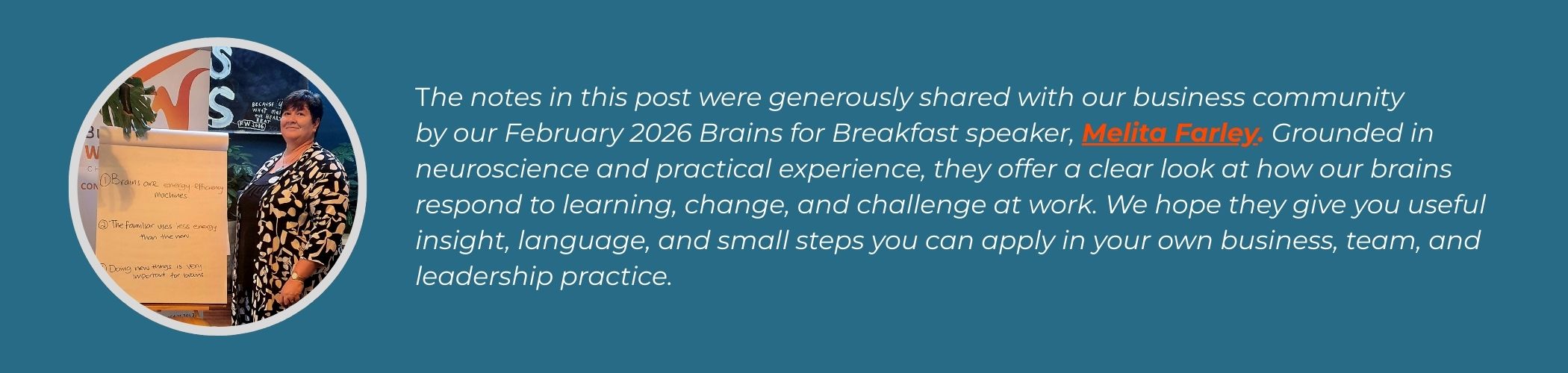
1. Brains are energy-efficient machines.
Our brains are energy hogs! They account for about 2% of our body weight, but use 20% – 25% of our energy every single day. Having energy-efficient brains allowed us to evolve and survive. But without intervention, our brains will always choose energy efficiency instead of change.
2. The familiar uses less energy than the new.
Our brains prefer the familiar (what we are used to) even when the familiar is not what we want, and even when the familiar isn’t physically or emotionally safe.
To conserve energy, our brains can make us feel that the new is potentially more dangerous than anything we are familiar with (fear of change, anyone?). Our brains will favour those already established synaptic super-highways until new pathways become well-trodden.
3. Doing new things is very important for our brains.
Doing new things helps us create new synaptic pathways! It also helps us grow new brain cells at every age, and makes us more tolerant and accepting of others and ourselves! Doing new things (as long as they are positive) generally makes us better people.
Importantly, doing new things contributes to our sense of achievement and strengthens our belief that we can do them!
The COM-B framework
So, what does this all mean for how we can manage our own learning and change or make it easier for the people who work with us?
The COM-B framework helps us think about all of the things our brain needs not only to help us learn or change, but to make that change last.
Capability + Opportunity + Motivation = Behaviour change
Capability
We need the skills, knowledge, and physical ability to do whatever the new thing is.
This is where we (as individuals and organisations) tend to put a lot of our energy – the ‘training’ part of the equation. We take courses, read books, watch videos, and get instructed. This is where we consciously begin building new synaptic pathways.
Unfortunately, we often stop here, expecting change to happen and last. We’re left ‘technically’ knowing how to do the new thing, but find it difficult to do it consistently or comfortably. We haven’t built a new synaptic super-highway yet, so our brain keeps dragging us back to what is familiar unless we do more.
Opportunity
To build our synaptic super-highway, we need reminders and opportunities to practice.
Our environment (both physical and social) needs to support us to change and to keep doing things in new ways. If we have this support, the amount of brain energy we need to use reduces. It is easier to keep doing the new thing, which keeps us building our synaptic super-highway.
We need systems and processes to make change easier. We also need visible reminders – little nudges that remind us to keep working on change even when we’re tired, stressed, disappointed, or emotional.
Motivation
Believing we can change is one of the most important drivers of successful change, and is one-half of the motivation equation. The most effective way we can help ourselves, and others believe we can change, is to have been successful at change in the past. This means we need to carefully break change down into small, actionable steps. Tiny actions lead to success, and success leads to believing we can change.
The other half of the motivation equation is having a reason for change. The most effective reasons align with our values and beliefs – we can see that change will be meaningful for us.
A Final Word on Fear
Fear makes our brains even more focused on energy efficiency and on the familiar – even when we have the capability and opportunity to change. Successful change relies on us finding ways to reduce our fear and support our brains.
Recent Comments